

Virtual exhibition “Australian Lithuanians. Part 5”
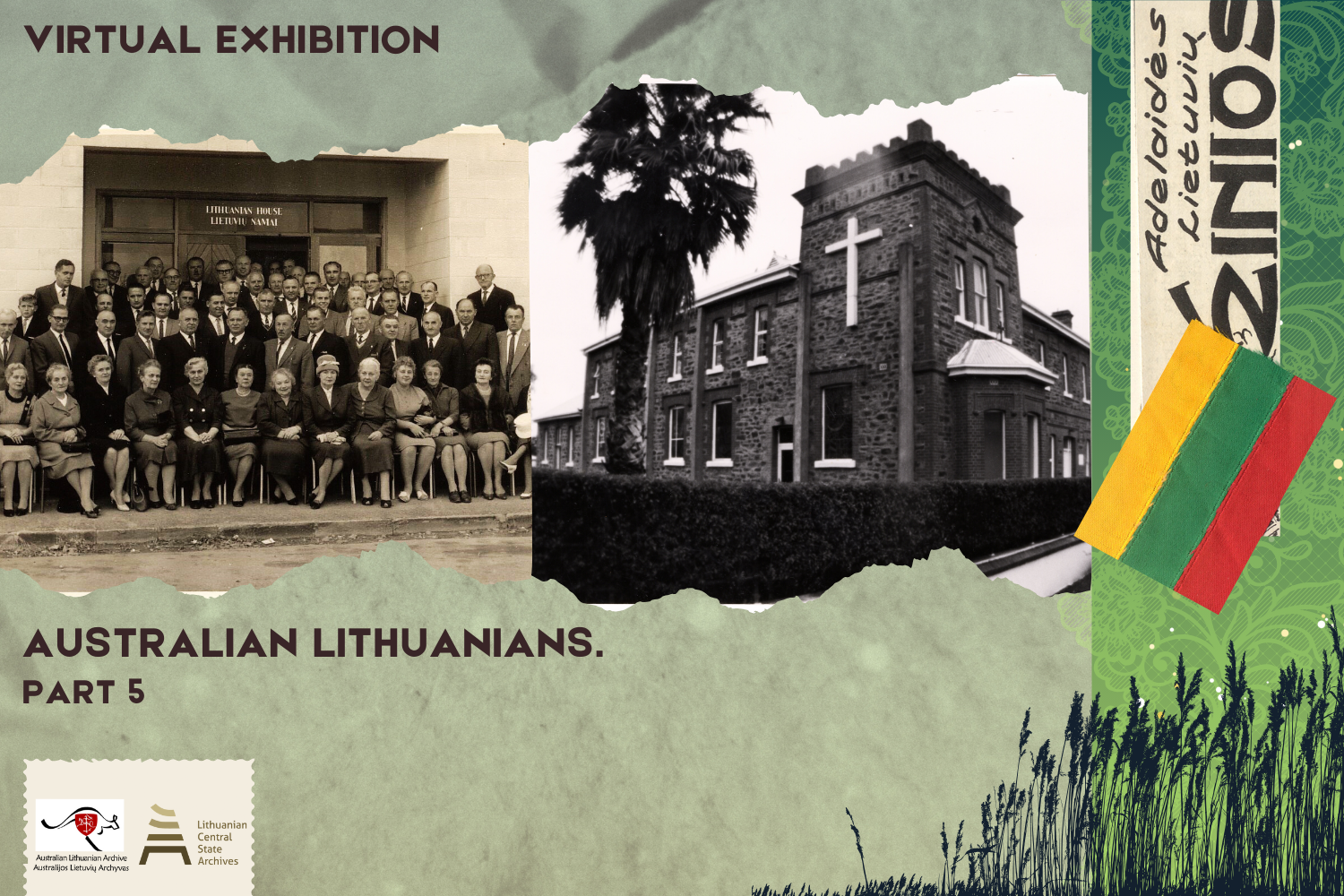
In commemoration of the 75th anniversary of the Lithuanian community in Australia, the Lithuanian Central State Archives, together with the Australian Lithuanian Archives, invite you to explore the history of Lithuanian settlement and community life on the Australian continent. Continuing our ten-part virtual exhibition dedicated to Australian Lithuanians, the fifth installment—open throughout 2025—focuses on two centers of Lithuanian identity in Adelaide: the Adelaide Lithuanian Society with its Lithuanian House, and the Adelaide Lithuanian Catholic Centre with St. Casimir’s Lithuanian Chapel.
Over time, the Lithuanian community of South Australia developed around two main organizations: the Adelaide Lithuanian Society and Lithuanian Caritas. The Society owns and manages the Lithuanian House, while Caritas oversees the Adelaide Lithuanian Catholic Centre, home to the only Lithuanian church in Australia. Although these organizations have pursued different paths and emphasized different areas of activity, they have often collaborated and, together, represent a single integrated community.
The virtual exhibition “Australian Lithuanians. Part 5” presents two sections: “The Adelaide Lithuanian Society and the Lithuanian House” and “Lithuanian Caritas, the Adelaide Lithuanian Catholic Centre, and St. Casimir’s Lithuanian Chapel.” Visitors will find photographs of the boards of both organizations, members of the Lithuanian Catholic Women’s Society and the Women’s Section of the Adelaide Lithuanian Community, as well as images documenting the reconstruction of the Lithuanian House, parish gatherings, and religious processions in Adelaide. The exhibition also features photographs of the Catholic Centre, the statutes of Lithuanian Caritas, Adelaide Lithuanian Society membership cards, the Lithuanian House opening program, press articles, and more.
As in previous installments, the exhibition draws on documents preserved in the Australian Lithuanian Archives. We express our gratitude to Daina Pocius for making these valuable materials available to the wider public.
We invite you to explore the exhibition.